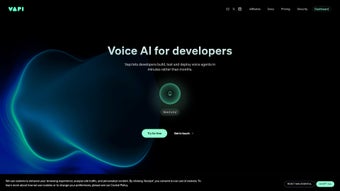

Download Vapi – AI Voice Agent Builder, Fast Integration, Secure Cloud Platform
Overview
Vapi is a cloud‑based AI voice generator built specifically for developers who need to create, test, and deploy voice agents quickly and securely. In today’s fast‑paced software market, adding conversational voice capabilities can differentiate a product, but traditional pipelines often involve weeks of recording, phonetic tweaking, and extensive QA. Vapi eliminates those bottlenecks by offering a subscription‑driven environment where voice models are generated on demand, integrated through simple APIs, and validated with an embedded testing suite.
The platform supports a variety of use‑cases—from interactive voice response (IVR) systems and smart‑home assistants to in‑app narration and accessibility features—making it a versatile tool for any development team. By handling the heavy lifting of voice synthesis, phoneme alignment, and latency optimization, Vapi lets engineers focus on core business logic rather than audio engineering. The service is hosted on a secure, GDPR‑compliant infrastructure, ensuring that voice data and user interactions remain private.
Moreover, Vapi’s pricing model is transparent, with tiered plans that scale from indie developers to enterprise teams, allowing you to start for free, test the water, and upgrade as your voice agent usage grows. Whether you are building a prototype for a hackathon or rolling out a production‑grade call center assistant, Vapi promises a streamlined workflow, reduced time‑to‑market, and a consistent, high‑quality voice experience.
Key Features & Benefits
- Instant Voice Generation: Create realistic, natural‑sounding voice agents in seconds using pre‑trained neural models.
- API‑First Integration: RESTful endpoints and SDKs for JavaScript, Python, and Java simplify embedding Vapi into any stack.
- Built‑In Testing Console: Real‑time playback, latency metrics, and pronunciation checks ensure agents work before deployment.
- Multi‑Language Support: Over 30 languages and regional accents are available, enabling global reach without extra plugins.
- Version Control & Rollback: Each voice build is versioned, allowing developers to revert to previous iterations instantly.
- Scalable Cloud Architecture: Auto‑scaling compute resources guarantee low latency even during peak traffic.
- Security & Compliance: End‑to‑end encryption, role‑based access, and GDPR/CCPA compliance protect sensitive voice data.
- Custom Voice Branding: Upload proprietary voice samples to fine‑tune a unique brand voice that matches your corporate tone.
- Analytics Dashboard: Monitor usage, error rates, and user sentiment through built‑in analytics, helping you iterate faster.
- Continuous Updates: Monthly model improvements and new language packs are delivered automatically, keeping your agents up‑to‑date.
The combination of these features translates into tangible benefits for development teams. Time saved on audio engineering can be redirected toward UI/UX improvements or new product features. The API‑first design removes the need for custom audio pipelines, while the testing console catches pronunciation errors early, reducing costly post‑release patches. Security features give peace of mind to enterprises handling personally identifiable information (PII) over voice channels. Finally, the analytics suite provides actionable insights that help refine dialogue flows, improve user satisfaction, and demonstrate ROI to stakeholders.
Installation, Usage & Compatibility
Getting Started in Minutes
Vapi is a purely web‑based service, so there is no traditional installer to download. To begin, visit vapi.ai, create a free account, and generate an API key from the dashboard. The key is the only credential you’ll need for all subsequent calls. For local testing, Vapi provides a lightweight CLI (available via npm) that lets you preview generated speech without leaving your terminal:
npm install -g vapi-cli
vapi generate --text "Hello, welcome to Vapi!" --voice en-US-Standard-A
For production environments, integrate the SDK of your choice. The JavaScript SDK, for example, can be added with a single line:
import Vapi from 'vapi-sdk';
const client = new Vapi({ apiKey: 'YOUR_API_KEY' });
client.synthesize('Your prompt here', { voice: 'en-GB-Standard-B' })
      .then(audio => {/* play or store audio */});
Operating System Support
Because Vapi runs in the cloud, it works on any operating system that can make HTTPS requests. Whether you develop on Windows 10/11, macOS Ventura, Linux distributions, or mobile platforms such as Android and iOS, the same API endpoints apply. The SDKs are cross‑platform, and the CLI runs on Windows, macOS, and major Linux flavors. This universality makes Vapi a perfect fit for heterogeneous teams that use mixed development environments.
Deployment Considerations
When integrating Vapi into a production pipeline, follow these best practices: store your API key in environment variables or secret management tools (e.g., Azure Key Vault, AWS Secrets Manager); enable request throttling to respect rate limits; and cache generated audio when possible to reduce latency and cost. Vapi also supports webhook callbacks for asynchronous generation, allowing you to offload long‑running synthesis tasks without blocking your application’s main thread. The platform’s SLA guarantees 99.9% uptime, and its global edge network ensures low latency regardless of the user’s geographic location.
Pros, Cons & Frequently Asked Questions
Pros
- Fast voice generation reduces development cycles dramatically.
- Extensive language and accent library for global products.
- API‑first design fits seamlessly into modern CI/CD pipelines.
- Built‑in testing console catches errors early.
- Scalable cloud infrastructure handles high‑traffic scenarios.
- Robust security and compliance for enterprise use.
Cons
- Subscription pricing may be a barrier for very small hobby projects.
- Limited offline capability – requires internet connectivity.
- Custom voice training needs a minimum amount of proprietary data.
FAQ
Can I use Vapi for commercial products?
Yes. Vapi’s licensing terms allow commercial deployment, and the enterprise tier includes extended usage limits, SLA guarantees, and dedicated support.
How does Vapi ensure data privacy?
All voice data is encrypted in transit (TLS 1.3) and at rest (AES‑256). Vapi is GDPR and CCPA compliant, and you can opt‑out of data retention for generated audio.
What is the pricing model?
Vapi offers a free tier with 1,000 characters per month, a developer plan at $29/mo, and an enterprise plan with custom pricing based on volume and SLA requirements.
Do I need to train a model for each language?
No. Vapi ships pre‑trained neural models for each supported language. Custom voice branding is optional and requires uploading a small dataset of your own recordings.
Is there a limit on the length of generated speech?
Each request can handle up to 2,500 characters. For longer scripts, split the text into multiple calls or use the asynchronous batch endpoint.
Overall, Vapi delivers a compelling mix of speed, quality, and developer‑friendly tools. The pros far outweigh the cons for teams that need reliable voice AI without building their own infrastructure.
Conclusion & Call to Action
In a landscape where voice interaction is becoming a core component of user experience, Vapi stands out as a secure, fast, and developer‑centric platform. By abstracting the complexities of voice synthesis, offering an extensive feature set, and ensuring compliance with major data‑privacy regulations, Vapi empowers developers to ship voice agents in days rather than weeks. Whether you are a solo indie coder looking for a free entry point or a large enterprise needing robust SLAs and custom branding, Vapi scales to meet those demands. To experience the speed and quality yourself, sign up for a free account today and start generating voice agents that sound natural, perform reliably, and delight your users.